
How Artificial Intelligence Can Solve Inventory Forecasting Challenges For Fashion Startups?
Here's everything you need to know! - TechStories Edition 2

During one of my frequent deep dives into business strategy videos on YouTube, I came across an episode of The Numbers Game featuring Fisayo Longe, founder of the fast-growing fashion brand KAI Collective. She highlighted a challenge familiar to many early-stage fashion entrepreneurs: overestimating demand. As a bootstrapped business in its first year, KAI Collective faced financial strain due to excess inventory, with much-needed cash tied up in unsold stock.
This issue is not unique to the KAI collective. In a joint report, Business of Fashion (BoF) and Mckinsey estimated that fashion brands overproduced 2.5 to 5 billion garments in 2023. The report also stated that inaccurate stock purchasing across sizes is estimated to lead to an average profit loss of up to 20% (Business of Fashion, McKinsey, 2025). For many new fashion brands without venture capital funding, such a significant loss can be catastrophic.
Overstocking is not a new issue in fashion. To address this, brands have experimented with various inventory strategies. However, these solutions often fall short for startups with limited capital. Traditional stock demand forecasting methods heavily rely on past sales, which puts new fashion companies with no past sale data at a disadvantage.
What if artificial intelligence (AI) could level the playing field for bootstrapped fashion brands while addressing the limitations of traditional forecasting and other strategies designed to tackle the inventory issues in the fashion industry? In this edition of TechStories, we’ll explore how AI can revolutionize inventory management, reduce financial risk, and help fashion startups thrive in an increasingly complex market.
The Problem: Traditional Inventory Strategies Fall Short for Bootstrapped Fashion Brands.
Aside from using mathematical methods to forecast stock, some brands try to eliminate overstock through alternative strategies:
On-Demand Production: Producing items only after receiving customer orders. While this prevents overstock, it delays cash flow since revenue is only generated after production and then sale. Additionally, it can lead to slower delivery times, which may frustrate customers and increase the risk of lost sales, as modern shoppers expect fast shipping.
Test-and-React: Producing a small initial batch, launching it, and scaling based on demand. This requires frequent upfront investment with no guaranteed success. Small-batch production also raises per-unit costs and slows down scaling.
External factors further complicate stock demand forecasting. Climate change has made weather patterns unpredictable, affecting demand for seasonal apparel (Business of Fashion, McKinsey, 2025). Additionally, consumer shopping behavior has shifted; purchases are now spread across multiple sales channels—including social media, email, and e-commerce—unlike the past, when brands primarily operated through brick-and-mortar stores. Traditional mathematical models are unable to account for these changes and their impact on clothing demand. AI, however, can integrate diverse data sources and adapt to real-time market shifts, making it a far more effective solution for new brands.
Why AI is the Future of Stock Demand Forecasting and Crucial for Fashion startups with limited capital?
The fashion industry’s overproduction problem extends beyond financial losses,it has significant environmental consequences. In 2020, the industry overproduced 30–40% of its inventory each season, contributing to 8–10% of global carbon emissions (Forbes, 2020). This has led to stricter government regulations:
The European Union will ban fashion brands from destroying unsold inventory starting in 2026 (Business of Fashion, McKinsey, 2025).
California now requires apparel companies to submit a sustainability plan for collecting, repairing, and recycling goods by 2030 (Business of Fashion, McKinsey, 2025).
For fashion startups, accurate demand forecasting is now a financial and legal necessity. A report from Statistic Brain found that only 47% of fashion startups survive beyond four years, often due to cash flow mismanagement (FashionInnovation, 2023). Reducing overproduction through AI-powered forecasting could help brands improve cash flow, maintain financial stability and remain competitive.
How Artificial Intelligence Can Solve These Inventory Forecasting Challenges
One of AI’s key advantages is its ability to learn complex patterns across diverse data sources and make decisions based on its learning. AI models can convert clothing designs into numerical data, assess external factors like weather and market trends, and predict demand across multiple sales channels. With real-time machine learning, AI can continuously process new information, adjusting stock demand forecasts as market conditions change.
Unlike traditional purely statistical forecasting methods that rely heavily on years of historical sales data, AI-powered forecasting can generate accurate predictions using alternative datasets. This allows startups to make informed inventory decisions from day one, making AI a game-changer for emerging fashion brands.
Data Collection Ideas for Startups
AI-powered forecasting can work without extensive past sales data by leveraging alternative sources. Real-time alternative datasets can be collected to train AI models for accurate demand predictions:
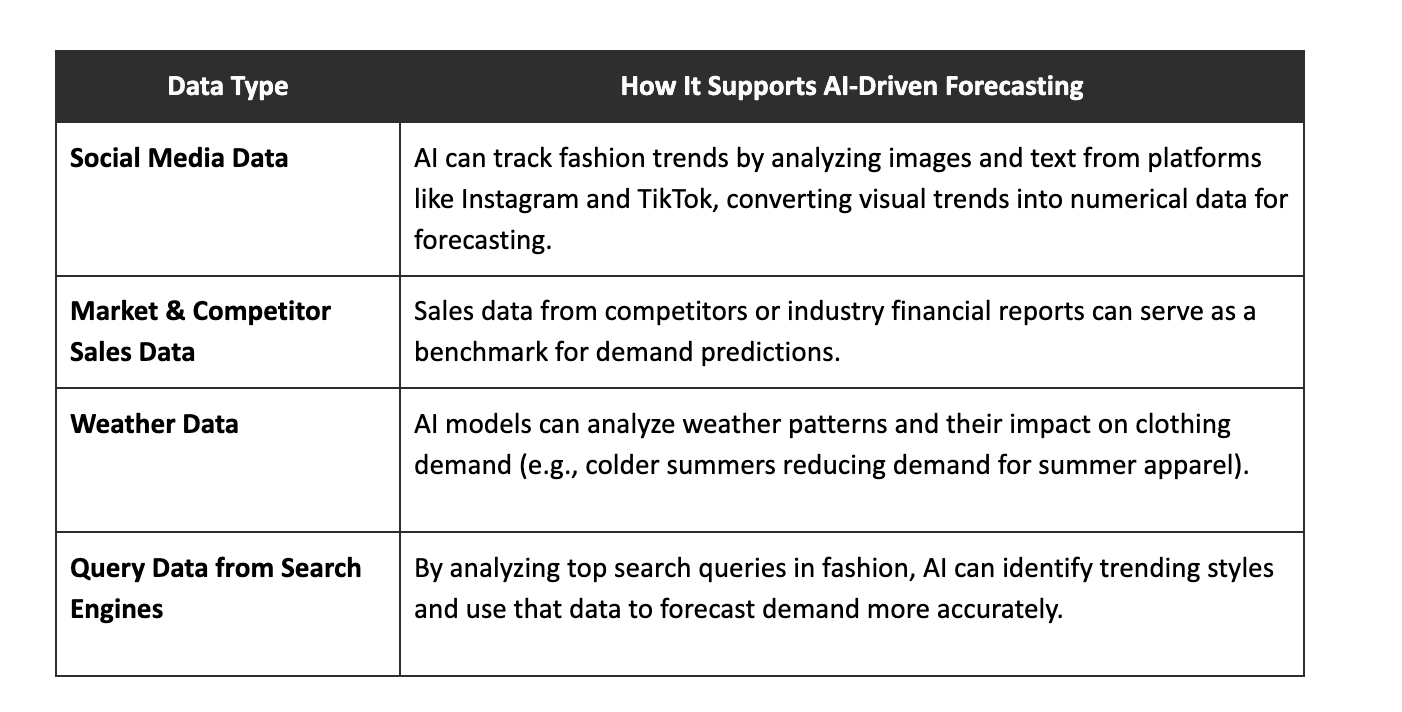
While AI doesn’t require years of brand-specific past sales data, the accuracy of its predictions improves with high-quality, diverse datasets.However, it's crucial to ensure compliance with data privacy laws when collecting and utilizing external data.
Final Thoughts: Why AI is a Game-Changer for Fashion Startups
For bootstrapped fashion brands, inventory mismanagement can mean the difference between survival and failure. AI-powered demand forecasting reduces overproduction, improves cash flow, and ensures sustainability, all while adapting to real-time market shifts.
As government regulations tighten and customer expectations evolve, AI is no longer just an advantage—it’s a necessity.
What Do You Think?
What are your thoughts on AI’s role in addressing the fashion industry’s supply chain problems for new brands? I would love to hear from you! Let’s start a conversation.
Citations:
Tackling Fashion’s excess inventory problem. The Business of Fashion. (n.d.). https://www.businessoffashion.com/articles/retail/the-state-of-fashion-2025-report-inventory-excess-stock-supply-chain/#:~:text=Excess%20stock%20in%20the%20fashion,to%20struggle%20with%20inventory%20positions
Magnusdottir, A. (2020, May 13). How fashion manufacturing will change after the coronavirus. Forbes. https://www.forbes.com/sites/aslaugmagnusdottir/2020/05/13/fashions-next-normal/?sh=77e3885578f3
7 reasons why fashion brands fail. Fashinnovation. (2023, November 6). https://fashinnovation.nyc/7-reasons-why-fashion-brands-fail/
The fundamentals of real-time machine learning. RSS. (2023, July 14). https://quix.io/blog/fundamentals-real-time-machine-learning
Such a good read!!! It was so interesting to find out about how AI could transfigure management and help companies reduce financial risk and thrive in an increasingly competitive market.
Such an insightful read! Well done 👏🏾♥️♥️♥️